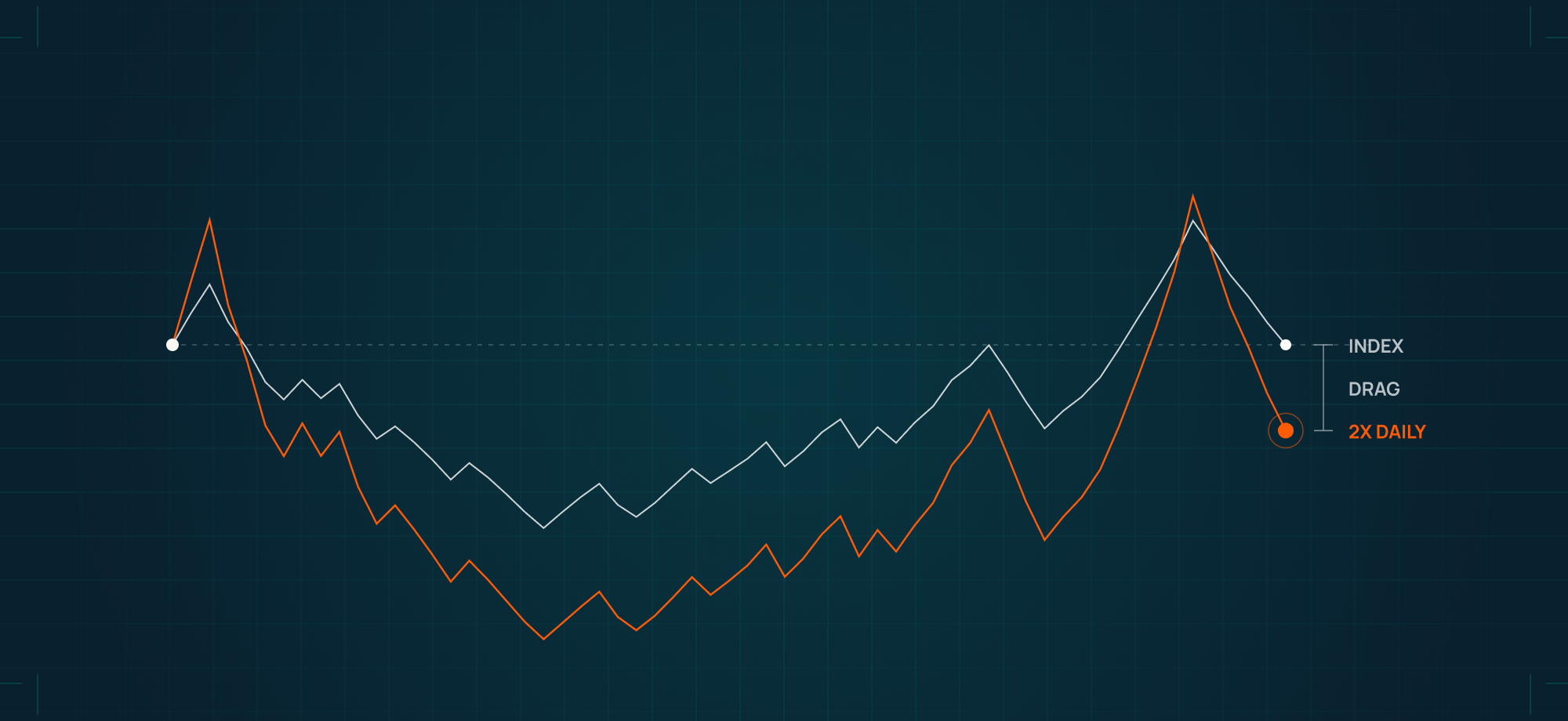
Last month we flagged that investor positioning had become extreme, with leveraged ETFs and margin debt both surging. Within the month, that latent risk became real. When borrowed money buys an investment that then loses value, the account can fall below its required minimum and force a sale at the worst possible time. That is a margin call.
The numbers
| Index | July return |
|---|---|
| S&P 500 | -0.02% |
| ACWI ex-US | -1.28% |
| Aggregate Bond | -1.13% |
Index returns are unmanaged and do not reflect fees; you cannot invest directly in an index.
The unwind
The S&P 500 returned almost exactly zero in July, but high-momentum stocks (the prior year's biggest winners) posted their worst monthly drawdown in roughly four years. Goldman's prime desk called it the largest reduction in tech exposure in over a decade.
The clearest example was the collapse of Situational Awareness, the AI-focused hedge fund run by a former OpenAI researcher. The fund grew from $225 million at inception to roughly $45 billion by the start of July, running a concentrated, roughly 4x-levered bet on the hardware behind the AI boom: memory-chip and infrastructure names such as SK Hynix, SanDisk, and CoreWeave. As those positions fell more than 40% and the fund's software short bets also moved against it, the margin calls started. Situational Awareness had to sell its entire public equity book at a discount, and its assets fell from about $45 billion to roughly $10 billion.
The irony is lost on no one: a fund named Situational Awareness was concentrated and levered on a single theme at the peak. Warren Buffett put it best: "Over the years, a number of very smart people have learned the hard way that a long string of impressive numbers multiplied by a single zero always equals zero."
Earnings: who's converting AI spend into profit
Four years into the AI capex boom, the spending is enormous, but only some companies are turning it into profit.
- Microsoft showed the capex converting to profits. Azure grew 43% and crossed $100 billion in annual revenue for the first time, with operating margins improving to 45%.
- Meta's results were more mixed. Revenue rose 28% year over year to $60.8 billion, and the core advertising business looks healthy (impressions up 14%, price per ad up 12%). But total expenses jumped 55% to $42 billion (nearly twice the revenue growth rate), and management raised full-year capex guidance to $130 billion to $145 billion. Meta generated $31.9 billion of operating cash flow and spent $31.1 billion on capex.
- Samsung said it expects the chip shortage to persist into 2028. Windfall profits at memory names seem likely to continue.
The political overlay
We expect politics to matter more for markets in the months ahead. Public antipathy toward AI is rising and could become a political factor. A recent Gallup poll found that 79% of Americans expect AI to reduce jobs over the coming decades, and 61% are concerned about its power consumption. Among adults aged 18 to 29, 47% now say AI does more harm than good. A message that reduces to "this technology will take your job and raise your electricity bill" is a hard one to sell politically.
What we're investigating
Single-stock correlation has skyrocketed lately, meaning the market is differentiating between winners and losers rather than treating the entire market as a block. This is a great backdrop for stock pickers. We're thinking about stocks that seem to be priced for very different earnings cycles—Intel at 55x P/E versus Micron at 6x, for example. We're also searching for overlooked, steady growers away from the AI excitement: businesses unlikely to be disrupted by technology.
How we're positioned
Our clients felt neither the euphoria nor the despair of the leveraged crowd this month. We hold measured exposure to the AI and technology themes alongside out-of-favor value stocks, international equities, gold, and bonds. The goal is durability: portfolios that compound over many years without the permanent loss of capital that turns a strong track record into a single zero.
What we're reading
- The CAPE that Cried Wolf by Dino Palazzo (SSRN)
- The AI Economy: A Roadmap (The Idea Farm, PDF)
Important disclosures
Brightward Financial LLC is a Registered Investment Advisor in the State of Colorado that provides investment advisory services, financial planning, and wealth management to individuals and businesses. Advisory services are offered only to clients and prospective clients where Brightward Financial LLC and its representatives are properly registered or exempt from registration. Nothing in this article should be construed as a solicitation or offer to sell advisory services in any jurisdiction where Brightward Financial LLC is not registered or exempt.
This article is provided for general informational purposes only and should not be considered personalized investment advice or a recommendation to buy or sell any security. Opinions expressed are those of Brightward Financial LLC as of the date of publication and are subject to change without notice.
This article may contain forward-looking statements, including earnings estimates, price targets, valuations, and projected financial results. Actual results may differ materially from those anticipated, and forward-looking statements are not guarantees of future performance.
All investments involve risk, including the potential loss of principal. Past performance is not indicative of future results. Index returns are unmanaged, do not reflect the deduction of fees or expenses, and are not available for direct investment.
Information in this article is sourced from publicly available data believed to be reliable but not independently verified. Brightward Financial LLC makes no representation or warranty, express or implied, as to its accuracy, completeness, or timeliness.
Brightward Financial LLC and its principals, employees, or affiliates may hold long or short positions in securities mentioned here, and any such positions held at the time of publication are disclosed in the relevant content. As of the date of publication, Brightward Financial LLC and/or its principals hold long positions in Micron, Microsoft, and Meta. Brightward Financial LLC does not accept compensation from any company mentioned in this article in exchange for favorable coverage or commentary.
Brightward Financial LLC's Form ADV Part 2A and Part 2B describe our advisory services, fees, and material conflicts of interest in greater detail. Both are available upon request and at adviserinfo.sec.gov.